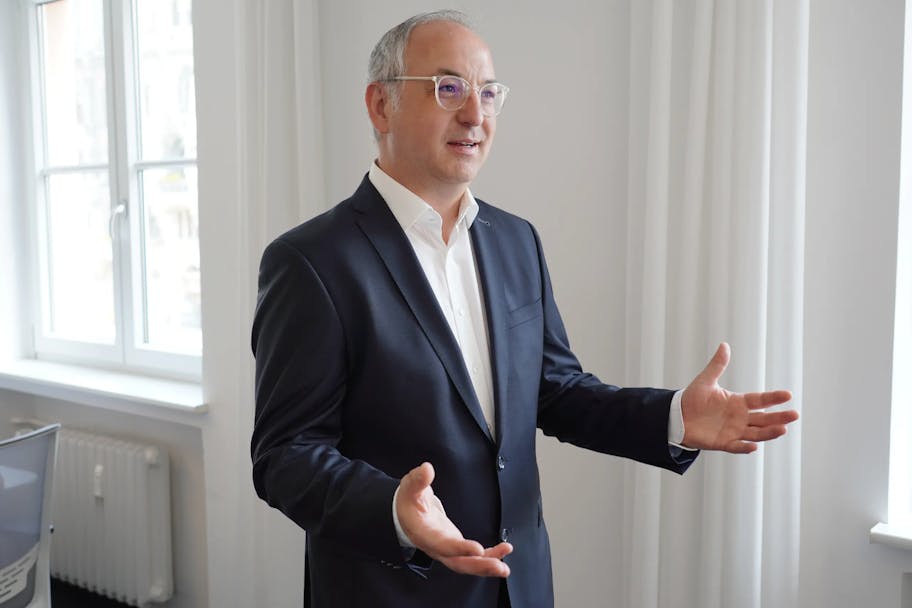
CEO positioning agency for visibility, reputation, and trust

Making the CEO visible — with attitude, substance, and strategy

Do you want to position your CEO clearly and credibly? As a CEO positioning agency, we make leaders visible — both internally and externally. CEO positioning is the strategic development and communication of a leader’s public profile: attitude, topics, and presence are sharpened in such a way that visibility creates trust, reputation, and impact for the company.

Why is this critical to success today? Stakeholders want to experience the person at the top. Studies show that around 48% of stakeholders prefer to hear a company’s vision directly from the CEO — more than from any other voice. And the personal voice of a leader generates significantly more resonance than that of the brand.

This is exactly where we come in. As a specialized CEO positioning agency, we combine strategy, content, and presence into a coherent profile — authentic, substantial, and sustainable over the long term. The focus is not on a quick effect, but on positioning that fits the personality and contributes to the company’s goals.

Contact

Would you like to know how CEO positioning can strengthen your company? Talk to us about your CEO’s profile, topics, and presence.


Definition, objective, and differentiation from CEO communication

What is CEO positioning?

CEO positioning is the strategic shaping of a leader’s public profile. It defines what a CEO stands for, which topics they own, how they come across — and makes this stance visible through the right formats and channels. The goal is to build trust among relevant stakeholders and strengthen the company’s reputation.

Closely connected to this is CEO communication: while CEO positioning lays the strategic foundation — profile, topics, narrative — CEO communication covers ongoing implementation: posts, speeches, interviews, LinkedIn presence, and dialogue with target groups.

The two interlock: without clear positioning, communication remains arbitrary; without continuous communication, positioning remains theory.

CEO positioning must also be distinguished from pure personal branding: it is not about self-promotion, but about a substantive stance that makes a recognizable contribution to the discourse and credibly contributes to the company’s strategy.

The concrete benefit for your company

Why CEO positioning is critical to success

Today, trust is built through people, not logos. Especially in B2B and in the mid-sized sector, purchasing decisions are often prepared long before the first direct contact — and stakeholders trust a company’s experts and leaders more than the brand itself. A clearly positioned CEO thus becomes the company’s most credible ambassador.

The numbers are clear: personal posts by leaders generate around twice as much engagement as corporate posts, cost significantly less per qualified contact, and convert many times better. In the eyes of algorithms — and increasingly also AI answer systems — the CEO’s voice is more effective than the brand’s.

CEO positioning therefore contributes to several goals at once: it strengthens reputation and trust among customers, investors, and partners; makes the company more attractive as an employer and supports talent acquisition;

creates attention for the company’s strategic topics; and builds a resilient foundation of trust in times of crisis.

For companies, CEO positioning is therefore not image maintenance, but a strategic lever for reputation, demand, and competitiveness — with a direct connection to the goals of executive management.

In addition, strong personal visibility for the CEO is also an investment in crisis resilience. Those who build trust and an established voice in good times can draw on it in difficult phases — and will be heard when it really matters.

Why complex B2B companies benefit in particular

CEO positioning in the B2B buying process and the mid-sized sector

CEO positioning has a particularly strong impact in B2B and in the mid-sized sector. Complex purchasing decisions are often prepared over months — long before the first direct contact takes place. In this phase, decision-makers look to people and experts for orientation, not to glossy brochures. A visible CEO with a clear expert profile thus becomes a decisive anchor of trust.

Platforms such as LinkedIn are no longer “just a channel,” but the central place where trust is built for complex B2B topics in the DACH region. While the corporate page serves as an anchor, actual visibility comes through the personal profiles of leaders and subject-matter experts.

CEO communication and the positioning of other key people within the company reinforce each other.

For hidden champions, this is a particular opportunity: companies that lead technologically but are barely perceived publicly can finally gain the visibility that reflects their market position through clear CEO positioning — making it easier to convince talent, customers, and partners.

Authenticity beats volume

CEO communication: making attitude visible, building trust

CEO communication today is driven by people. Platforms such as LinkedIn no longer reward reach at any price, but relevance, credibility, and consistency. What matters is not posting as much as possible, but taking a substantive and recognizable stance on a few relevant topics.

The principle is clear: authenticity beats volume. Programs written entirely by third parties quickly come across as inauthentic. The most effective approaches keep the CEO involved in the content — their language, their examples, their convictions. We provide structure, topics, preparation, and refinement without replacing the CEO’s voice. Video is also increasingly becoming a central format for credibility, and dialogue — responding substantively to comments and questions — has more impact than any one-way message.

Good CEO communication is therefore not a loose stream of posts, but the consistent, recognizable visibility of a stance — across LinkedIn, speeches, interviews, podcasts, and specialist articles.

Continuity is important: a single strong statement quickly fades, while consistent CEO communication over months builds a resilient profile. Better one substantial and authentic contribution per week than arbitrary AI-generated posts every day — quality and attitude beat frequency.

Developing CEO positioning systematically

Our approach: the Ruess CEO Impact Framework

Effective CEO positioning does not arise from individual posts, but from a clear process. For this purpose, we have developed the Ruess CEO Impact Framework — a five-phase model that connects analysis, profile, narrative, orchestration, and impact, making CEO positioning plannable, authentic, and measurable.

  • Phase 1 — Context and expectation horizon

    At the beginning is an understanding of the environment: What is moving the industry and the company? Which topics concern internal and external stakeholders? How do opinion-leading media frame the relevant issues, and how is the competition positioning itself in the discourse? This creates points of connection where the CEO can credibly engage.

  • Phase 2 — Profile and attitude

    In the next step, we sharpen the profile: What does the CEO stand for? Which convictions, values, and principles shape them, which priorities drive them, and how do they want to come across? We determine their communicative strengths and natural tonality — the guardrails of authentic positioning.

  • Phase 3 — Narrative and topics

    On this basis, we develop topics and storylines: Where can the CEO provide impulses, and which long-term, sustainable narratives can be shaped from them? The goal is a clear thread that remains recognizable beyond individual posts and contributes to the company’s strategic topics.

  • Phase 4 — Orchestrating formats and channels

    Now we translate the positioning into implementation: through LinkedIn posts, video, newsletters, interviews, podcasts, speeches, and specialist articles. The formats are orchestrated in a way that fits the CEO’s personality and time budget — consistent rather than erratic, with genuine dialogue instead of pure self-presentation.

  • Phase 5 — Impact and reputation protection

    Finally, we make impact measurable — through reach, resonance, tonality, and contribution to reputation and business goals. At the same time, we consider reputation protection: from crisis preparedness to dealing with misinformation and deepfakes. This makes CEO positioning not only visible, but also resilient.

Across all five phases, the framework ensures consistency and a recognizable common thread: instead of individual actions, a profile emerges that holds over time, fits the personality, and grows with the company’s goals.

When to speak — and when not to

Attitude with judgment: CEO positioning in a polarized world

CEOs are increasingly asked to take a stance on societal issues. A clear position can strengthen trust and reputation — but only if it is perceived as authentic and credible. Studies show that CEO engagement on controversial topics can improve reputation when the underlying motivation is experienced as honest and value-driven, and that it can cause harm when it appears self-serving or arbitrary.

Knowing when it is better to remain silent is therefore just as important as speaking. In a polarized environment, the goal is not more commentary, but better commentary: on topics that fit the person and the company, with a stance that can be credibly upheld even in the face of headwinds. We help CEOs find this line and hold it consistently.

Specifically, we prepare CEOs to act with confidence even in sensitive moments — with prepared positions on foreseeable topics, clear guardrails, and the necessary composure not to respond to every provocation. This keeps the positioning resilient even when the discourse becomes heated.

An established, authentic voice is the best protection

Protecting reputation in the age of AI: deepfakes and CEO impersonation

With public visibility comes a new risk: AI-generated deepfakes and CEO impersonation. Just a few seconds of audio or video material are enough to imitate a leader with deceptive authenticity — for fraud as well as as a reputational weapon designed to deliberately undermine the trust of investors, customers, and partners. In early 2026, for example, the Bombay Stock Exchange had to warn against deepfake videos of its CEO. Executive impersonation is now considered a board-level issue, no longer just an IT topic.

Professionally developed CEO positioning is part of the defense here: an established, authentic, and consistent voice makes it easier to recognize fakes as such and to counter them credibly.

We therefore consider reputation protection, verification logic, and crisis communication from the very beginning of CEO positioning — so that, in a critical situation, the response can be fast, confident, and controlled.

In this way, CEO positioning itself becomes a building block of resilience: the clearer and more credible the public profile, the harder it is for fakes to destroy trust — and the faster they can be exposed and put into context.

Typical occasions

Who benefits from CEO positioning

CEO positioning is particularly worthwhile when visibility and trust make a concrete difference. Typical occasions include:

  • A new CEO taking office. A new CEO needs to build a clear profile and trust among all stakeholders early on.
  • Transformation and change. In change processes, a visible, credible CEO provides orientation and confidence.
  • Succession in the mid-sized sector. When leadership is handed over to the next generation or to external management, positioning creates continuity and credibility.
  • Skilled workers and employer branding. A profiled CEO makes the company more attractive as an employer and draws in talent.
  • Investors and growth. Ahead of financing rounds, an IPO, or expansion, a clearly positioned CEO strengthens trust among capital providers.
  • Hidden champions. Technologically leading but publicly little-known companies gain urgently needed visibility through CEO positioning.

From strategy to implementation

Services of our CEO positioning agency

As a CEO positioning agency, we support the entire process — strategically grounded and reliable in implementation:

  • Analysis and positioning strategy

    Context and stakeholder analysis, competitor and discourse monitoring, and the development of the overarching positioning strategy.

  • Profile, attitude, and narrative

    Sharpening profile, values, and tonality, as well as developing sustainable topics and narratives that fit the personality and corporate strategy.

  • Content, LinkedIn, and thought leadership

    Editorial support for posts, LinkedIn presence, video, and specialist articles — with the CEO as an involved voice, not a replaced one.

  • Media, speeches, and appearances

    Preparation for interviews, media appearances, keynotes, and podcasts, as well as professional media coaching.

  • Reputation and crisis protection

    Crisis preparedness, monitoring, and dealing with misinformation and deepfakes — so that reputation remains resilient even under pressure.

  • Impact measurement and steering

    Definition of metrics, monitoring of reach, resonance, and tonality, as well as continuous optimization of the positioning.

We combine these services flexibly — from a focused positioning project to continuous support as a CEO positioning agency over several months. Depending on maturity level and objectives, we set the right priorities and build visibility step by step.

How CEO positioning creates impact

In practice: excerpts from our work

Industrial company in transformation: For a CEO leading their company through profound change, we developed a clear profile and topic agenda that credibly carried the transformation course both internally and externally — creating orientation and trust in a phase of uncertainty.

Mid-sized hidden champion: For the leadership of a little-known but technologically leading mid-sized company,

we sharpened positioning and narrative and systematically built visibility — so that the company’s specialist strength finally gained a face and a voice.

In both cases, the same pattern emerges: visibility does not happen overnight, but through a clear profile, relevant topics, and consistent, authentic communication over time.

The neutral outside perspective

CEO consulting: why an agency makes the difference

Good CEO consulting brings an advantage that internal teams can rarely provide: an independent, honest outside perspective. It tells a CEO what they may not want to hear, realistically assesses their impact, and translates personality into a sustainable public role — without bending them out of shape.

When choosing a partner, experience with leaders, discretion, strategic thinking, and editorial substance are decisive. A specialized agency for CEO positioning combines these competencies and ensures that good intentions become a consistent, credible profile — one that holds over years.

Strategy, substance, and discretion

Why companies choose Ruess Group as their CEO positioning agency

As part of our communication consulting and our field of impact Strategy, Reputation & Corporate Leadership, we combine CEO positioning and CEO communication with a systematic approach — the Ruess CEO Impact Framework. This turns visibility into genuine impact.

We work with leaders from industry, the mid-sized sector, and technology, and understand the specific requirements of complex topics and multi-layered stakeholders.

As part of our communication consulting, CEO positioning, change communication, and crisis communication interlock seamlessly.

We see ourselves as a sparring partner on equal footing: discreet, substantial, and with the necessary sensitivity for personality and impact. We do not replace the CEO’s voice — we make it heard.

Contact

Talk to us about the positioning of your CEO — about profile, topics, presence, and reputation protection.

FAQs

Frequently Asked Questions
about CEO Positioning

  • CEO positioning is the strategic shaping of a leader’s public profile. It defines what a CEO stands for, which topics they own, and how they come across, and makes this stance visible through the right formats and channels — with the aim of building trust and strengthening the company’s reputation.

  • CEO positioning lays the strategic foundation: profile, attitude, topics, and narrative. CEO communication is the ongoing implementation — posts, speeches, interviews, LinkedIn presence, and dialogue with target groups. The two belong together: positioning without communication remains theory, while communication without positioning remains arbitrary.

  • A CEO positioning agency develops and steers the public profile of a leader: from context and stakeholder analysis to profile, attitude, and narrative, through to content, LinkedIn, media, and reputation protection. It provides strategy, structure, and refinement — while keeping the CEO involved as the authentic voice.

  • In the context of communication, CEO consulting supports leaders in developing their public role, attitude, and impact. Its greatest value is the independent outside perspective: honest feedback, strategic assessment, and the translation of personality into credible, sustainable positioning.

  • LinkedIn today rewards relevance, credibility, and consistency rather than reach alone. What works is taking a substantive stance on a few relevant topics with clear attitude, using video selectively, and entering into genuine dialogue — with the CEO as an involved voice rather than merely the recipient of ghostwritten content.

  • An established, authentic, and consistent CEO voice makes it easier to identify fakes and counter them credibly. This is supported by monitoring, clear verification and response paths, and a prepared crisis communication plan to respond quickly and confidently to deepfakes and impersonation.

  • The cost depends on scope, objectives, and intensity — from a focused positioning strategy to continuous support over several months. What matters is the balance between effort and impact: credible CEO positioning contributes to reputation, talent acquisition, and business development at the same time.

  • Through clearly defined metrics: reach and resonance of contributions, tonality and quality of responses, development of reputation among target groups, and contribution to business and recruiting goals. Continuous monitoring makes it possible to sharpen the positioning on an ongoing basis.

  • CEO positioning is particularly valuable when a CEO takes office, during transformation or succession situations, ahead of financing rounds or expansion, in employer branding, and for hidden champions that need more visibility. Wherever trust and visibility make a business difference, CEO positioning pays off.

  • Personal branding often focuses on visibility and self-presentation. CEO positioning is more strategic: it connects the person of the CEO with the company’s goals and topics, and focuses on attitude and substance rather than visibility alone. The result is trust that contributes to the company.

  • We work in close collaboration with the CEO: we provide strategy, topics, structure, research, and editorial refinement — but the voice, examples, and convictions remain those of the CEO. Fully outsourced programs quickly feel inauthentic; involved CEOs are more credible and more effective.

  • A sound positioning strategy is often developed within a few weeks. Visible impact — reach, resonance, reputation — then builds continuously over several months, because trust and a recognizable profile require time and consistency.